
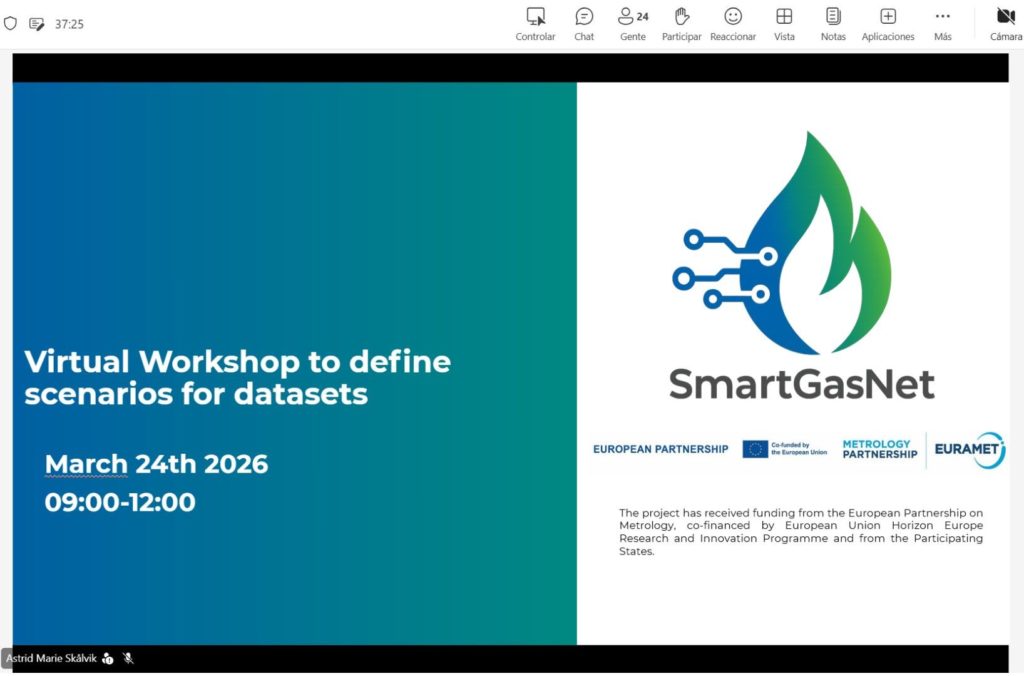
To enable the uptake of renewable hydrogen and biomethane into gas grids, the SmartGasNet project hosted a stakeholder workshop on Tuesday, 24 March 2026. The goal of the workshop was to get feedback on the process conditions and metering station configurations explored in the project, to ensure relevance for stakeholders
The workshop explored three different subjects that SmartGasNet is working on. First, the attendees reviewed several experimental data sources, including available experimental data sets, field data, and planned laboratory tests. The experimental data sources will provide time-resolved data that is difficult to get, as most of the data comes from the regular activities of TSOs and DSOs. Simulating scenarios that replicate changes in real-world situations in flow rate, pressure, temperature, and gas composition within the gas grids, SmartGasNet will create a dataset for those gas flows, to enable the study and modelling of autocorrelation effects.
Then, attendees reviewed the specifications for synthetic data sets: input ranges, process conditions, and assumptions for the synthetic data generation. The discussion focused mainly on the measurement scenario that should be prioritised in the tests, in terms of fluctuations, flow rates and variations. Emphasis was also placed on parameterising noise levels, amplitudes, and frequencies, as well as on metering station configurations and sources of uncertainty.
Lastly, the project covered the data requirements for the training data set to create a Machine Learning tool. The consortium explained which data will be needed for this tool, which aims to predict gas flows when there are no instruments available. During this session, the need for data covering appropriate operating ranges and including metadata related to uncertainty and calibration was emphasised.
The workshop was organised by the Norwegian Research Centre (NORCE) with the support of the European Gas Research Group, the University of Ljubljana, the Lithuanian Energy Institute, and the VSL National Metrology Institute. A warm thank you to the contributions of the attendees, SmartGasNet will fast forward the path to the clean transition by upscaling biomethane and hydrogen utilisation within the European infrastructure.